Genocchi number
In mathematics, the Genocchi numbers Gn, named after Angelo Genocchi, are a sequence of integers that satisfy the relation
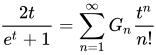
The first few Genocchi numbers are 1, −1, 0, 1, 0, −3, 0, 17 (sequence A036968 in the OEIS), see OEIS: A001469.
Properties
- The generating function definition of the Genocchi numbers implies that they are rational numbers. In fact, G2n+1 = 0 for n ≥ 1 and (−1)nG2n is an odd positive integer.
- Genocchi numbers Gn are related to Bernoulli numbers Bn by the formula

There are two cases for .

- 1. from OEIS: A027641 / OEIS: A027642
- 2. from OEIS: A164555 / OEIS: A027642
- = -1, -1, 0, 1, 0, -3 = OEIS: A226158(n+1). Generating function: .


OEIS: A226158 is an autosequence (a sequence whose inverse binomial transform is the signed sequence) of the first kind (its main diagonal is 0's = OEIS: A000004). An autosequence of the second kind has its main diagonal equal to the first upper diagonal multiplied by 2. Example: OEIS: A164555 / OEIS: A027642.
−OEIS: A226158 is included in the family:
| ... | ... | 1 | 1/2 | 0 | -1/4 | 0 | 1/2 | 0 | -17/8 | 0 | 31/2 |
| ... | 0 | 1 | 1 | 0 | -1 | 0 | 3 | 0 | -17 | 0 | 155 |
| 0 | 0 | 2 | 3 | 0 | -5 | 0 | 21 | 0 | -153 | 0 | 1705 |
The rows are respectively OEIS: A198631(n) / OEIS: A006519(n+1), −OEIS: A226158, and OEIS: A243868.
A row is 0 followed by n (positive) multiplied by the preceding row. The sequences are alternatively of the second and the first kind.
Combinatorial interpretations
The exponential generating function for the signed even Genocchi numbers (−1)nG2n is
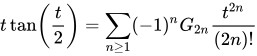
They enumerate the following objects:
- Permutations in S2n−1 with descents after the even numbers and ascents after the odd numbers.
- Permutations π in S2n−2 with 1 ≤ π(2i−1) ≤ 2n−2i and 2n−2i ≤ π(2i) ≤ 2n−2.
- Pairs (a1,…,an−1) and (b1,…,bn−1) such that ai and bi are between 1 and i and every k between 1 and n−1 occurs at least once among the ai's and bi's.
- Reverse alternating permutations a1 < a2 > a3 < a4 >…>a2n−1 of [2n−1] whose inversion table has only even entries.
See also
References
- Weisstein, Eric W. "Genocchi Number". MathWorld.
- Richard P. Stanley (1999). Enumerative Combinatorics, Volume 2, Exercise 5.8. Cambridge University Press. ISBN 0-521-56069-1
- Gérard Viennot, Interprétations combinatoires des nombres d'Euler et de Genocchi, Seminaire de Théorie des Nombres de Bordeaux, Volume 11 (1981-1982)
- Serkan Araci, Mehmet Acikgoz, Erdoğan Şen, Some New Identities of Genocchi Numbers and Polynomials