F-flat major
F♭ major (or the key of F♭) is a theoretical key based on F♭, consisting of the pitches F♭, G♭, A♭, B , C♭, D♭, and E♭ Its key signature has six flats and one double flat.[1]
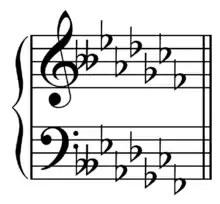 | |
| Relative key | D♭ minor enharmonic: C♯ minor |
|---|---|
| Parallel key | F♭ minor enharmonic: E minor |
| Dominant key | C♭ major enharmonic: B major |
| Subdominant | B major enharmonic: A major |
| Enharmonic | E major |
| Component pitches | |
| F♭, G♭, A♭, B, C♭, D♭, E♭ | |
The F♭ major scale is:
Its relative minor is D♭ minor, usually replaced by C♯ minor (see reason below) and its parallel minor is F♭ minor, usually replaced by E minor, since F♭ minor's four double-flats make it generally impractical to use. Because of that, it is usually enharmonic to E major with 4 sharps.
Music in F♭ major
Although F♭ major is usually notated as its enharmonic equivalent of E major, because E major has four sharps only as opposed to F♭ major's eight flats (including the B), part of Richard Strauss' Metamorphosen uses F♭ major, which one commentator has called "a bitter enharmonic parody" of the earlier manifestations of E major in the piece.[2]
Beethoven also used F♭ major in his Piano Sonata No. 31, Op. 110. In the first movement's exposition, the transitional passage between the first and second subjects consists of arpeggiated figuration beginning in A♭ major and modulating to the dominant key of E♭ major. In the recapitulation, the key for this passage is changed to bring the second subject back in A♭ major: the transitional passage appears in a key that would theoretically be F♭ major, but which is notated in E major, presumably because Beethoven judged this easier to read – this key being a major third below the key of the earlier appearance of this passage. Likewise, the second movement (in A♭ major) of Beethoven's Piano Sonata No. 8 (Pathétique) contains six measures of what would theoretically be F♭ major, but notated as E major (keeping the 4-flat key signature of the movement, so every note in the passage has an accidental).
Another example of F♭ major being notated as E major can be found in the Adagio of Haydn's Trio No. 27 in A♭ major. The Finale of Bruckner's Symphony No. 4 employs enharmonic E for F♭, but its coda employs F♭ directly, with a phrygian cadence through F♭ onto the tonic.[3][4][5]
An example of F♭ major being used directly is in Victor Ewald's Quintet No. 4 in A♭ major (Op. 8), where the entirety of the third movement is notated in this key.[6]
The climax that occurs in the middle of Samuel Barber's Adagio for Strings resolves to F♭ major.
References
- Nicolas Slonimsky (1960). The Road to Music. New York: Dodd, Mead, & Co. p. 16.
- Bryan Randolph Gilliam (1998). Richard Strauss: New Perspectives on the Composer and His Work. Duke University Press. p. 237. ISBN 0-8223-2114-9.
- Donald Betts (2005). "Beethoven's Piano Sonata Opus 110". The Inner Voice.
- James Arnold Hepokoski and Warren Darcy (2006). Elements of Sonata Theory: Norms, Types, and Deformations in the Late-Eighteenth-Century Sonata. Oxford University Press. pp. 326. ISBN 0-19-514640-9.
- Julian Horton (2004). Bruckner's Symphonies: Analysis, Reception and Cultural Politics. Cambridge University Press. pp. 127. ISBN 0-521-82354-4.
- "Ewald: Quintet No 4 in Ab, op 8". Ensemble Publications. Ensemble Publications. Retrieved 1 June 2016.