Biomphalaria pfeifferi
Biomphalaria pfeifferi is a species of air-breathing freshwater snail, an aquatic pulmonate gastropod mollusk in the family Planorbidae, the ram's horn snails.
| Biomphalaria pfeifferi | |
|---|---|
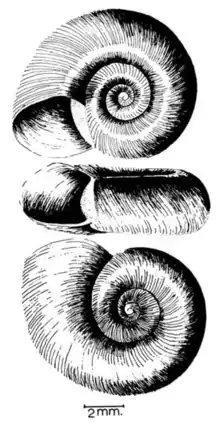 | |
| Drawing of apical, apertural and umbilical view of the shell of Biomphalaria pfeifferi. | |
| Scientific classification | |
| Kingdom: | |
| Phylum: | |
| Class: | |
| (unranked): | |
| Superfamily: | |
| Family: | |
| Subfamily: | Planorbinae |
| Tribe: | Biomphalariini |
| Genus: | |
| Species: | B. pfeifferi |
| Binomial name | |
| Biomphalaria pfeifferi | |
This snail is a medically important pest,[2] because of transferring the disease schistosomiasis.
Distribution
Biomphalaria pfeifferi is an African species. It has recently expanded its native range.[2]
Distribution of Biomphalaria pfeifferi include:
The type locality is Umgani-Valley, Natal, South Africa[1] (in the times of the description it was the British Colony of Natal).
Phylogeny
A cladogram showing phylogenic relations of species in the genus Biomphalaria:[4]
| Biomphalaria |
| ||||||||||||||||||||||||||||||||||||||||||||||||||||||||||||||||||||||||||||||||||||||||||||||||||||||||||||||||||||||||||||||||||||||||||||||||
Ecology
Biomphalaria pfeifferi can survive up to 16 hours in anaerobic water using lactic acid fermentation.[5]
Parasites
Parasites of Biomphalaria pfeifferi include the following 11 species found in Tanzania:[6]
Toxicology
The seeds of the tree Balanites aegyptiaca have a molluscicide effect on Biomphalaria pfeifferi.[8]
| Substance | Route | LC50 | Reference |
|---|---|---|---|
| Powder of crude kernels of Balanites aegyptiaca | immersion(?) | 60 ppm | [8] |
| Acetone extract of powder of the kernels of Balanites aegyptiaca | immersion(?) | 172,40 ppm | [8] |
| Ethanol extract of the powder of kernels of Balanites aegyptiaca | immersion(?) | 84,15 ppm | [8] |
Ethanolic extract of the fruits of Dalbergia sissoo (family Leguminosae) exhibited molluscicidal effect against eggs of Biomphalaria pfeifferi.[9]
References
- (in German and Latin) Krauss F. (1848). Die Sudafrikanischen Mollusken. Ebnert & Seubert, Stuttgart, 140 pp, 6 plates. page 83, plate 5, figure 7.
- Pointier, J. P.; Pointier, J. P.; David, P.; Jarne, P. (2005). "Biological invasions: The case of planorbid snails". Journal of Helminthology. 79 (3): 249–256. doi:10.1079/JOH2005292. PMID 16153319.
- (in French) Sarr A., Kinzelbach R. & Diouf M. (2011, in press). "Diversité spécifique et écologie des mollusques continenatux de la basse vallée du Ferlo (Sénégal). [Specific diversity and ecology of continental molluscs from the Lower Ferlo Valley (Senegal)]". MalaCo 7: 8 pp. PDF Archived 2011-10-02 at the Wayback Machine.
- Dejong, R. J.; Morgan, J. A.; Paraense, W. L.; Pointier, J. P.; Amarista, M.; Ayeh-Kumi, P. F.; Babiker, A.; Barbosa, C. S.; Brémond, P.; Pedro Canese, A.; De Souza, C. P.; Dominguez, C.; File, S.; Gutierrez, A.; Incani, R. N.; Kawano, T.; Kazibwe, F.; Kpikpi, J.; Lwambo, N. J.; Mimpfoundi, R.; Njiokou, F.; Noël Poda, J.; Sene, M.; Velásquez, L. E.; Yong, M.; Adema, C. M.; Hofkin, B. V.; Mkoji, G. M.; Loker, E. S. (2001). "Evolutionary relationships and biogeography of Biomphalaria (Gastropoda: Planorbidae) with implications regarding its role as host of the human bloodfluke, Schistosoma mansoni". Molecular Biology and Evolution. 18 (12): 2225–2239. doi:10.1093/oxfordjournals.molbev.a003769. PMID 11719572.
- Brand, T. V.; Baernstein, H. D.; Mehlman, B. (1950). "Studies on the anaerobic metabolism and the aerobic carbohydrate consumption of some fresh water snails". The Biological Bulletin. 98 (3): 266–276. doi:10.2307/1538675. JSTOR 1538675. PMID 15420230. PDF
- Loker, E S.; Moyo, H. G.; Gardner, S. L. (1981). "Trematode-gastropod association in nine non-lacustrine habitats in the Mwanza region of Tanzania". Parasitology. 83 (2): 381–399. doi:10.1017/s0031182000085383.
- Ibikounlé, M; Mouahid, G; Mintsa Nguéma, R; Sakiti, NG; Kindé-Gasard, D; Massougbodji, A; Moné, H (December 2012). "Life-history traits indicate local adaptation of the schistosome parasite, Schistosoma mansoni, to its snail host, Biomphalaria pfeifferi". Experimental Parasitology. 132 (4): 501–7. doi:10.1016/j.exppara.2012.09.020. PMID 23031799.
- Hamidou T. H., Kabore H., Ouattara O., Ouédraogo S., Guissou I. P. & Sawadogo L. (2002) "Efficacy of Balanites aegyptiaca(L.) DEL Balanitaceae as Anthelminthic and Molluscicid Used by Traditional Healers in Burkina Faso". International Conference on Emerging Infectious Diseases 2002. page 37. PDF
- Adenusi A. A. & Odaibo A. B. (2009). "Effects of varying concentrations of the crude aqueous and ethanolic". African Journal of Traditional, Complementary and Alternative medicines 6(2). abstract, PDF.
Further reading
- Nguma, J. F.; McCullough, F. S.; Masha, E. (1982). "Elimination of Biomphalaria pfeifferi, Bulinus tropicus and Lymnaea natalensis by the ampullarid snail, Marisa cornuarietis, in a man-made dam in northern Tanzania". Acta Tropica. 39 (1): 85–90. PMID 6122367.
- Utzinger, J.; Tanner, M. (2000). "Microhabitat preferences of Biomphalaria pfeifferi and Lymnaea natalensis in a natural and a man-made habitat in southeastern Tanzania". Memórias do Instituto Oswaldo Cruz. 95 (3): 287–294. doi:10.1590/S0074-02762000000300002. PMID 10800185.
- Wright C. A. (1963). "The freshwater gastropod mollusca of Angola". Bulletin of the British Museum (Natural History) 10(8): 447-528. 16 plates. page 455.