Big East Men's Basketball Tournament
The Big East Men's Basketball Tournament is the championship tournament of the Big East Conference in men's basketball. The winner receives the conference's automatic bid to the NCAA Men's Division I Basketball Championship. Since 1983, the tournament has been held in Madison Square Garden, New York City. As such, the tournament is the longest running conference tournament at any one site in all of college basketball.
| Big East Men's Basketball Tournament | |
|---|---|
| Conference Basketball Championship | |
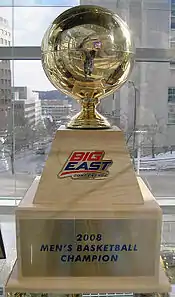 The 2008 Big East Men's Basketball Tournament trophy | |
| Sport | College basketball |
| Conference | Big East Conference |
| Number of teams | 10 |
| Format | Single-elimination tournament |
| Current stadium | Madison Square Garden |
| Current location | New York City |
| Played | 1980–present |
| Last contest | 2019 |
| Current champion | Creighton Bluejays men's basketball |
| Most championships | Connecticut Huskies, Georgetown Hoyas (7) |
| Official website | BigEast.org |
| Host stadiums | |
| Madison Square Garden (1983–present) Hartford Civic Center (1982) Carrier Dome (1981) Providence Civic Center (1980) | |
| Host locations | |
| New York City (1983–present) Hartford, Connecticut (1982) Syracuse, New York (1981) Providence, Rhode Island (1980) | |
In 2011, Connecticut, led by Kemba Walker, became the first and only team in the Big East Tournament to ever win five games in five consecutive days to win the championship.
The 2009 tournament featured a six-overtime game in the quarterfinals between the Connecticut Huskies and the Syracuse Orange, in which Syracuse prevailed, 127–117. The game, the second longest in NCAA history, started on the evening of March 12 and ended nearly four hours later in the early morning of March 13.[1]
Only three players have achieved repeat MVP honors: Georgetown's Patrick Ewing (1984–1985), Louisville's Peyton Siva (2012–2013), and Villanova's Josh Hart (2015, 2017).
As part of the deal in which the original Big East split into the "new" Big East and the American Athletic Conference, the "new" Big East retained the rights to the conference tournament. The “new” Big East extended their contract to host the tournament at Madison Square Garden through the 2025 season.
On March 12, 2020, the 2020 tournament was cancelled during halftime of the first quarterfinal game due to the COVID-19 pandemic.[2] Despite the cancellation of the tournament, the conference was able to receive an insurance payout of $10.5 million as a result of the tournament's insurance policy.[3]
Seeding
In the last four tournaments before the Big East split into two leagues in 2013, all member schools participating in the tournament (16 from 2010 to 2012, and 14 in 2013) were seeded in the tournament based on their conference records. Non-conference games were ignored. Ties were broken using an elaborate set of tiebreaker rules, with the first two tiebreakers being head-to-head record and common record against the next best conference team.[4] The 2014 tournament, the first held after the split, involved all 10 members of the reconfigured Big East, with similar tiebreakers employed as needed. It is expected that all members will continue to play in future tournaments (barring postseason bans due to NCAA rules violations).
Prior to the 2009 tournament, only the top 12 teams in the conference competed. In 2009, the tournament expanded to include all 16 of the conference's teams. The teams seeded #9 through #16 played first-round games, teams seeded #5 through #8 received a bye to the second round, and the top four teams receive a double-bye to the quarter finals.[5] The final pre-split Big East tournament, held in 2013, saw only 14 teams compete—West Virginia left the Big East for the Big 12 Conference after the 2011–12 season, and Connecticut was barred from the tournament due to an NCAA postseason ban for academic reasons. In that tournament, the teams seeded #11 through #14 played in the first round, with byes remaining the same as in the 2010–12 period.
History
Championships by school
| Team | Winners | Winning Years |
|---|---|---|
| Georgetown | 1980, 1982, 1984, 1985, 1987, 1989, 2007 | |
| UConn | 1990, 1996, 1998, 1999, 2002, 2004, 2011 | |
| Syracuse | 1981, 1988, 1992, 2005*, 2006* | |
| Villanova | 1995, 2015, 2017, 2018, 2019 | |
| St. John's | 1983, 1986, 2000 | |
| Louisville | 2009, 2012, 2013 | |
| Seton Hall | 1991, 1993, 2016 | |
| Boston College | 1997, 2001 | |
| Pittsburgh | 2003, 2008 | |
| Providence | 1994, 2014 | |
| West Virginia | 2010 | |
| Marquette | ||
| Creighton | ||
| Xavier | ||
| DePaul | ||
| Butler | ||
- Italics indicate school is no longer a member of the Big East Conference.
Television coverage
Before the 2013 conference split, the Big East was the only conference to have every tournament game broadcast nationwide on the ESPN family of networks, with every game from the second round forward broadcast on ESPN. 2011 marked the first year the tournament was broadcast in 3D on ESPN 3D.
Beginning with the 2014 tournament, FS1 is the television home for the Big East tournament.[6]
References
- Thamel, Pete (March 13, 2009). "Syracuse Left Standing After Marathon Game". The New York Times. Retrieved April 26, 2010.
- St. John's vs. Creighton Box Score — March 12, 2020 https://theathletic.com/ The Athletic Retrieved May 19, 2020
- Caron, Emily (December 2, 2020). "Big East recoups $10.5 million from men's basketball tournament insurance policy". Sportico. Retrieved December 29, 2020.
- "Archived copy" (PDF). Archived from the original (PDF) on 2010-11-20. Retrieved 2011-02-28.CS1 maint: archived copy as title (link)
- "Big East tournament expands to 16 teams". United Press International. November 7, 2007. Archived from the original on 20 March 2008. Retrieved 2008-03-12.
- "Archived copy". Archived from the original on 2013-09-07. Retrieved 2013-09-06.CS1 maint: archived copy as title (link)