Bagua
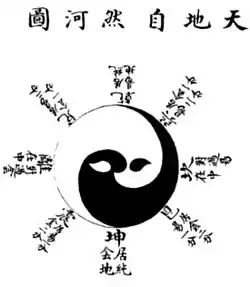
The Bagua, Pakua or Palgwae are eight symbols used in Taoist cosmology to represent the fundamental principles of reality, seen as a range of eight interrelated concepts. Each consists of three lines, each line either "broken" or "unbroken", respectively representing yin or yang, 0 or 1 forming binary numbers 000-111 (0 to 7). Due to their tripartite structure, they are often referred to as Eight Trigrams in English.
| Bagua | |||||||||||||||||||||
|---|---|---|---|---|---|---|---|---|---|---|---|---|---|---|---|---|---|---|---|---|---|
| Chinese name | |||||||||||||||||||||
| Chinese | 八卦 | ||||||||||||||||||||
| Literal meaning | Eight symbols | ||||||||||||||||||||
| |||||||||||||||||||||
| Vietnamese name | |||||||||||||||||||||
| Vietnamese | Bát quái | ||||||||||||||||||||
| Hán-Nôm | 八卦 | ||||||||||||||||||||
| Korean name | |||||||||||||||||||||
| Hangul | 팔괘 | ||||||||||||||||||||
| Hanja | 八卦 | ||||||||||||||||||||
| |||||||||||||||||||||
| Japanese name | |||||||||||||||||||||
| Kanji | 八卦 | ||||||||||||||||||||
| Hiragana | はっけ | ||||||||||||||||||||
| |||||||||||||||||||||
The trigrams are related to Taiji or Taegeuk philosophy, Taijiquan and the Wuxing, or "five elements".[1] The relationships between the trigrams are represented in two arrangements, the Primordial (先天八卦), "Earlier Heaven"[2] or "Fu Xi" bagua (伏羲八卦), and the Manifested (後天八卦), "Later Heaven,"[2] or "King Wen" bagua. The trigrams have correspondences in astronomy, astrology, geography, geomancy, anatomy, the family, and elsewhere.[3][4]
The ancient Chinese classic, I Ching (Pinyin: Yi Jing), consists of the 64 pairwise permutations of trigrams, referred to as "hexagrams", along with commentary on each one.
Trigrams
| Trigram lines | 乾 Qián ☰ 000 |
兌 Duì ☱ 001 |
離 Lí ☲ 010 |
震 Zhèn ☳ 011 |
巽 Xùn ☴ 100 |
坎 Kǎn ☵ 101 |
艮 Gèn ☶ 110 |
坤 Kūn ☷ 111 |
|---|---|---|---|---|---|---|---|---|
| Nature | Heaven/Firmament 天 Tiān | Lake/Marsh 澤 Zé | Heart of Fire 火 Huǒ | Thunder 雷 Léi | Wind 風 Fēng | Water 水 Shuǐ | Mountain 山 Shān | Ground 地 Dì |
| Element and planet | Metallic / Neptune | Metallic / Venus | Fiery / Mars | Wooden / Jupiter | Wooden / Pluto | Watery / Mercury | Earthy / Uranus | Earthy / Saturn |
| Ba Xian | Han Xiang Zi | Zhongli Quan | Lü Dongbin | Cao Guojiu | He Xiangu | Li Tieguai | Zhang Guolao | Lan Caihe |
| Personality | Philosophy | Holy Merrymaker | Sovereignty | Emperor (General) | Tao Yin (Wise) | Pilgrim | Warrior Hero | Feeling |
| Artifact | Flute | Hand fan | Sword | Castanet | Lotus | Calabash | Drum | Basket flower |
| Eight meridians[5] | Du Mai | Yin Wei Mai | Chong Mai | Yang Wei Mai | Yin Qiao Mai | Dai Mai | Yang Qiao Mai | Ren Mai |
| Chinese Dragon | Tianlong | Panlong, Feilong | Zhulong | Shenlong | Qinglong | Jiaolong, Dilong | Fuzanglong | Chilong |
| Starting acupuncture point | Hou Xi | Nei Guan | Gong Sun | Wai Guan | Zhao Hai | Zu Lin Qi | Shen Men | Lie Que |
| Acupuncture Channel | Xiao Chang | Xin Bao | Pi | San Jiao | Shen | Dan | Pang Guang | Fei |
| Chinese Zodiac | Sheep
Apollo |
Dog
Aphrodite |
Snake
Demeter |
Cat (pig)
Hermes |
Bird
Athena |
Rat
Dionysus |
Monkey
Ares |
Tiger
Hera |
| Zang-fu | Hand | Tai Yin | Jue Yin | Yang Ming | Shao Yin | Shao Yang | Tai Yang | Foot |
| Baduanjin | 兩手托天理三焦 | 左右開弓似射雕 | 調理脾胃順單舉 | 攢拳怒目增氣力 | 兩手攀足固腎腰 | 搖頭擺尾去心火 | 五勞七傷向後瞧 | 背後七顛百病消 |
| Chakra | Sahasrara | Ajna | Anahata | Vishuddha | Svadhishthana | Manipura | Muladhara | Bindu |
| Axis Points | Qianding | Yindang/Qiangjian | Danzhong/Shendao | Tiantu/Yamen | Shenque/Mingmen | Zhongwan/Jinsuo | Shimen/Yaoyangquan | Huiyin |
| Mid-body acupuncture point | 百會 | 強間 | 膻中, 神道 | 大椎 廉泉 | 神闕, 命門 | 脊中, 中脘 | 腰陽關, 氣海 | 華蓋, 會陰 |
| Action | Think, Sound (to) | See | Love | Say | Feel | Do / Have (Power) | Be | Exist |
| Bushido | Integrity | Respect | Courage | Honor | Compassion | Honesty | Loyalty | Self Control |
| Greek Titan Equivalent | Uranus (Father Sky) | Hemera (Day) | Ether (Fire) | Chaos (Storm, Chaotic) | Nyx (Tree) | Pontus (Sea) | Ourea (Mountain) | Gaia (Mother Earth) |
| Human body | Spirit | Nervous System | Circulatory System | Immune System | Reproductive System | Skeletal System | Excretory System | Muscle System |
| Virtue and Sin | Faith – Heresy | Abnegation – Envy | Chastity – Lust | Humble – Vanity | Dedication – Lazy | Temperance – Greedy | Patience – Wrath | Charity – Materialist |
| 24 Hours | 12 | 9 | 6 | 3 | 15 | 18 | 21 | 0 |
| 360 degrees | 180 | 135 | 90 | 45 | 225 | 270 | 315 | 0 |
| Cardinal Direction (Antarctic Opposite) | South (North) | South-East (North-East) | East | North-East (South-East) | South-West (North-West) | West | North-West (South-West) | North (South) |
| Energy | Solar | Wind | Thermal | Electric | Organic | Hydric | Fossil | Gravitational |
| Nature Event | Star Blows (Magnectic Fields) Meteor Comet | Hurricane | Forest Fires | Lightning Storm | Disease Plague | Tsunami Flood | Volcanic Eruption | Earth Quake |
| Trigram Lines Image | Full, All (Force) | Bucket (Washer, Purifying) | Sphere (Cyclic) | Cup (Drinker, Taster) | Bridge (Helper) | Target (Dangerous) | Gate, Door (Guardian, Keeper, Key) | Empty, Nothing (Darkness) |
| Arctic Season (Antarctic Opposite) | Summer Solstice 21 June | 7 May | Spring Equinox 21 March | 7 February (Azure Dragon) | 7 August (Vermilion Bird) | Fall Equinox 21 September | 7 October | Winter Soltice 21 December (White Tiger) |
| Feng Shui Number (King Wen/Fu Xi)
5 Center |
6/9 | 7/4 | 9/3 | 3/2 | 4/8 | 1/7 | 2/6 | 8/1 |
| Human Body | Head | Arm/Shoulder | Breasts/Thorax | Forearm/Hand | Thigh/Glutes | Abdomen | Knee/Foot | Womb |
| Bone | Skull | Humerus | Rib Cage | Radius/Ulna | Femur | Spinal Cord | Tibia/Fibula | Pelvis |
| Endocrine glands | Pineal | Pituitary | Thymus | Thyroid | Ovary | Pancreas | Testis | Adrenal |
Relation to other principles
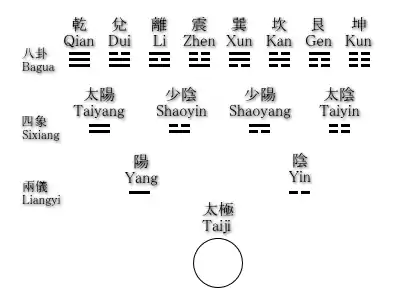
There are two possible sources of bagua. The first is from traditional Yin and Yang philosophy. This is explained by Fuxi in the following way:
無極生有極、
有極是太極、
太極生兩儀、
即陰陽。
兩儀生四象:
即少陰、太陰、
少陽、太陽、
四象演八卦、
八八六十四卦。Wújí shēng yǒují,
yǒují shì tàijí.
Tàijí shēng liǎngyí,
jí yīnyáng.
Liǎngyí shēng sìxiàng:
jí shǎoyīn, tàiyīn,
shǎoyáng, tàiyang
Sìxiàng yǎn bāguà,
bā bā liùshísì guàThe Limitless (無極; Wuji) produces the Delimited (有極; Youji),
and this Delimited is equivalent to the Highest Limit (太極; Taiji), or the Absolute.
The Taiji (i.e. the two opposing forces in embryonic, unmanifested form) produces two forms Liangyi (兩儀),
namely yin-yang(陰陽), the manifested opposing forces.
These two forms produce four phenomena:
namely: lesser yin (少陰, shaoyin), and greater yin (太陰, taiyin, which also refers to the Moon);
lesser yang (陽, shaoyang), and greater yang (太陽, taiyang, which also refers to the Sun).
The four phenomena (四象; sìxiàng) act on the eight trigrams (八卦; Bagua).
Eight 'eights' results in sixty-four hexagrams.
Another possible source of bagua is the following, attributed to King Wen of Zhou Dynasty: "When the world began, there was heaven and earth. Heaven mated with the earth and gave birth to everything in the world. Heaven is Qian-gua, and the Earth is Kun-gua. The remaining six guas are their sons and daughters".
The trigrams are related to the five elements of Wu Xing, used by Feng Shui practitioners and in Traditional Chinese Medicine. Those five elements are Water, Wood, Fire, Earth and Metal. The Water (Kan) and Fire (Li) trigrams correspond directly with the Water and Fire elements. The element of Earth corresponds with both the trigrams of Earth (Kun) and Mountain (Gen). The element of Wood corresponds with the trigrams of Wind (Xun) (as a gentle but inexorable force that can erode and penetrate stone) and Thunder (Zhen). The element of Metal corresponds with the trigrams of Heaven (Qian) and Lake (Dui).
There are eight possible combinations to render the various trigrams (八卦 bāguà):
| Trigram figure | Possible binary value | Name | Translation: Wilhelm[6] | Image in nature (pp.l-li) | Direction (p. 269) | Family relationship (p. 274) | Body part (p. 274) | Attribute (p. 273) | Stage/ state (pp.l-li) | Animal (p. 273) | |
|---|---|---|---|---|---|---|---|---|---|---|---|
| 1 | ☰ | 111 | 乾 qián | the Creative, (natural) force | heaven, sky 天 |
northwest | father | head | strong, persisting | creative | 馬 horse |
| 2 | ☱ | 110 | 兌 duì | the Joyous, open (reflection) | lake, marsh 澤 |
west | third daughter | mouth | pleasure | tranquil (complete devotion) | 羊 sheep, goat |
| 3 | ☲ | 101 | 離 lí | the Clinging, radiance | fire, glow 火 |
south | second daughter | eye | light-giving, humane "dependence" | clinging, clarity, adaptable | 雉 pheasant |
| 4 | ☳ | 100 | 震 zhèn | the Arousing, shake | thunder 雷 |
east | first son | foot | inciting movement | initiative | 龍 dragon |
| 5 | ☴ | 011 | 巽 xùn | the Gentle, ground | wind 風 |
southeast | first daughter | thigh | penetrating | gentle entrance | 雞 fowl |
| 6 | ☵ | 010 | 坎 kǎn | the Abysmal, gorge | water 水 |
north | second son | ear | dangerous | in-motion | 豕 pig |
| 7 | ☶ | 001 | 艮 gèn | Keeping Still, bound | mountain 山 | northeast | third son | hand | resting, stand-still | completion | 狗 wolf, dog |
| 8 | ☷ | 000 | 坤 kūn | the Receptive, field | earth 地 |
southwest | mother (consort) | belly | devoted, yielding | receptive | 牛 cow |
Hexagram lookup table


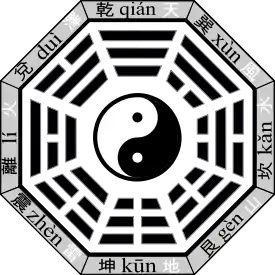
Fu Xi "Earlier Heaven"
| 卦名 Name |
自然 Nature |
季节 Season |
性情 Personality |
家族 Family |
方位 Direction |
意義 Meaning |
|---|---|---|---|---|---|---|
| 乾 Qián | 天 Sky (Heaven) | Summer | Creative | 父 Father | 南 South | 健 Expansive energy, the sky. For further information, see tiān. |
| 巽 Xùn | 風 Wind | Summer | Gentle | 長女 Eldest Daughter | 西南 Southwest | 入 Gentle penetration, flexibility. |
| 坎 Kǎn | 水 Water | Autumn | Abysmal | 中男 Middle Son | 西 West | 陷 Danger, rapid rivers, the abyss, the moon. |
| 艮 Gèn | 山 Mountain | Autumn | Still | 少男 Youngest Son | 西北 Northwest | 止 Stillness, immovability. |
| 坤 Kūn | 地 Earth | Winter | Receptive | 母 Mother | 北 North | 順 Receptive energy, that which yields. For further information, see dì. |
| 震 Zhèn | 雷 Thunder | Winter | Arousing | 長男 Eldest Son | 東北 Northeast | 動 Excitation, revolution, division. |
| 離 Lí | 火 Fire | Spring | Clinging | 中女 Middle Daughter | 東 East | 麗 Rapid movement, radiance, the sun. |
| 兌 Duì | 澤 Lake | Spring | Joyous | 少女 Youngest Daughter | 東南 Southeast | 悅 Joy, satisfaction, stagnation. |
This is also known as the "binary sequence" or Shao Yong sequence. A binary interpretation of each hexagram is made by interpreting yin as "0" and yang as "1", and reading the leading "digit" from the inside of the diagram, so the hexagram kūn is interpreted as 0, and gèn as 1. The hexagrams are in binary order when read up from the bottom around on the right, then up again on the left to the top.
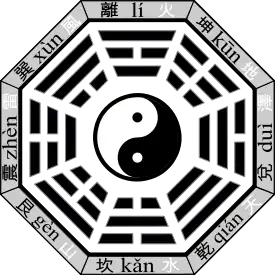
King Wen "Later Heaven"
| 卦名 Name |
自然 Nature |
季节 Season |
性情 Personality |
家族 Family |
方位 Direction |
意義 Meaning |
|---|---|---|---|---|---|---|
| 離 Li | 火 Fire | Summer | Clinging | 中女 Middle Daughter | 南 South | 麗 Pulsing motion, radiance, the luminaries. |
| 坤 Kun | 地 Earth | Summer | Receptive | 母 Mother | 西南 Southwest | 順 Receptive energy, that which yields. |
| 兌 Dui | 澤 Lake | Autumn | Joyous | 少女 Youngest Daughter | 西 West | 悅 Joy, satisfaction, stagnation. |
| 乾 Qian | 天 Heaven | Autumn | Creative | 父 Father | 西北 Northwest | 健 Expansive energy, the sky. |
| 坎 Kan | 水 Water | Winter | Abysmal | 中男 Middle Son | 北 North | 陷 Danger, rapid rivers, the abyss, the moon. |
| 艮 Gen | 山 Mountain | Winter | Still | 少男 Youngest Son | 東北 Northeast | 止 Stillness, immovability. |
| 震 Zhen | 雷 Thunder | Spring | Arousing | 長男 Eldest Son | 東 East | 動 Excitation, revolution, division. |
| 巽 Xun | 風 Wind | Spring | Gentle | 長女 Eldest Daughter | 東南 Southeast | 入 Gentle penetration, flexibility. |
Yellow River Map
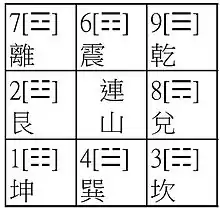
| 卦名 Name |
節氣 Solar Term |
屬性 Elements |
器官 Organs |
方位 Direction |
顏色 Color |
味道 Taste |
星相 Constellation |
體液 Body Fluid |
二進制 Binary |
情志 Mood |
|---|---|---|---|---|---|---|---|---|---|---|
| 巽 | Winter Solstice 冬至 | 陽火(Fire) | 腎 Kidneys | 北 North | 丹 Red | 鹹 Salty | 虛(Emptiness/Aquarius) | 血 Plasma | 011 | 恐 Fear |
| 坎 | Start of Winter 立冬 | 陰火(Fire) | 腸 Intestines | 西北 North West | 洋紅 Magenta | 鹹 Salty | 斗(Dipper/Sagittarius) | 血 Plasma | 010 | 恐 Fear |
| 兌 | Autumn Equinox 秋分 | 陰水(Water) | 肝 Liver | 西 West | 藍 Blue | 苦 Bitter | 房(Room/Scorpio) | 津 Liquid | 110 | 憂 Sullen |
| 乾 | Start of Autumn 立秋 | 陽水(Water) | 膽 Gallbladder | 西南 South West | 黑 Black | 苦 Bitter | 角(Horn/Virgo) | 津 Liquid | 111 | 憂 Sullen |
| 震 | Summer Solstice 夏至 | 陰木(Wood) | 肺 Lungs | 南 South | 青 Cyan | 辛 Spicy | 星(Star/Leo) | 氣 Air | 100 | 喜 Joy |
| 離 | Start of Summer 立夏 | 陽木(Wood) | 心 Heart | 東南 South East | 綠 Green | 辛 Spicy | 井(Well/Gemini) | 氣 Air | 101 | 喜 Joy |
| 艮 | Spring Equinox 春分 | 陽金(Metal) | 脾 Spleen | 東 East | 黃 Yellow | 酸 Sour | 昴(Hairy Head/Taurus) | 精 Essence | 001 | 怒 Anger |
| 坤 | Start of Spring 立春 | 陰金(Metal) | 胃 Stomach | 東北 North East | 白 White | 酸 Sour | 奎(Legs/Pisces) | 精 Essence | 000 | 怒 Anger |
Cycles of elements in this chart: 生 (Generative/Counter-clockwise), 剋 (Destructive/Clockwise)
火生水, 水生木, 木生金, 金生火
火剋金, 金剋木, 木剋水, 水剋火
Fire brings water, water feeds wood, wood brings metal, metal brings fire
Fire melts metal, metal chops wood, wood drains water, water quenches fire
Nine Halls Diagram
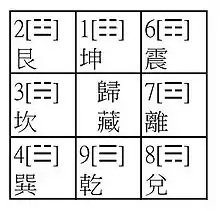
| 卦名 Name |
節氣 Solar Term |
屬性 Elements |
家族 Family |
方位 Direction |
顏色 Color |
脈搏 Pulse |
二進制 Binary |
四馬與治療法 Four horses & Therapy |
|---|---|---|---|---|---|---|---|---|
| 乾 | Winter Solstice 冬至 | 太陽陽水(Water) | 父 Father | 北 North | 黑 Black | 沉 Deep | 111 | 11太陽 ,寒者熱之00 |
| 兌 | Start of Winter 立冬 | 太陽陰水(Water) | 長女 Eldest Daughter | 西北 North West | 藍 Blue | 沉 Deep | 110 | 11太陽, 寒者熱之00 |
| 離 | Autumn Equinox 秋分 | 少陽陽木(Wood) | 中男Middle Son | 西 West | 綠 Green | 細 Small | 101 | 10少陽, 涼者溫之01 |
| 震 | Start of Autumn 立秋 | 少陽陰木(Wood) | 少女 Youngest Daughter | 西南 South West | 青 Cyan | 細 Small | 100 | 10少陽, 涼者溫之01 |
| 坤 | Summer Solstice 夏至 | 太陰陰金(Metal) | 母 Mother | 南 South | 白 White | 浮 Float | 000 | 00太陰, 熱者寒之11 |
| 艮 | Start of Summer 立夏 | 太陰陽金(Metal) | 長男 Eldest Son | 東南 South East | 黃 Yellow | 浮 Float | 001 | 00太陰, 熱者寒之11 |
| 坎 | Spring Equinox 春分 | 少陰陰火(Fire) | 中女 Middle Daughter | 東 East | 洋紅 Magenta | 大 Big | 010 | 01少陰, 溫者涼之10 |
| 巽 | Start of Spring 立春 | 少陰陽火(Fire) | 少男 Youngest Son | 東北 North East | 丹 Red | 大 Big | 011 | 01少陰, 溫者涼之10 |
Cycles of elements in this chart: 生(Generative/Counter-clockwise),剋(Destructive/Clockwise)
水生木,木生金,金生火,火生水
水剋火,火剋金,金剋木,木剋水
Water feeds wood, wood brings metal, metal brings fire, fire brings water
Water quenches fire, fire melts metal, metal chops wood, wood drains water
Bagua used in Feng Shui
The Bagua is an essential tool in the majority of Feng Shui schools. The Bagua used in Feng shui can appear in two different versions: the Earlier Heaven Bagua, used for burial sites, and the Later Heaven Bagua, used for the residences.
Orthodox Bagua
In the Chinese orthodoxy culture, five elements does not exist. In the ancient China, Chinese people created four elements theory as the earliest theory of Bagua. Historian expert from Hong Kong discovered the genuine versions of eight trigram should be follow the rule of clockwise Gold (Spring), Wood (Summer), Water (Autumn), Fire (Winter). Another Bagua must following Spring (Fire), Summer (Gold), Autumn (Wood), Winter (Water). Both Xiantian Bagua and Houtian Bagua were counterfeited versions promoted by Confucianisms.[7]
Xiantian Bagua
In Xiantian Bagua, also known as Fu Xi Bagua or Earlier Heaven Bagua, the Heaven is in the higher part and the Earth is in the lower part. The trigram Qian (Heaven) is at the top, the trigram Kun (Earth) is at the bottom (in the past, the South was located at the top in Chinese maps). The trigram Li (Fire) is located on the left and opposite to it is the trigram Kan (Water). Zhen (Thunder) and Xun (Wind) form another pair, while being one opposite the other, the first on the bottom left next to Li while the second is next to Qian on the top right of the Bagua. Gen (Mountain) and Dui (Lake) form the last pair, one opposite the other, both in balance and harmony. The adjustment of the trigrams is symmetrical by forming exact contrary pairs. They symbolize the opposite forces of Yin and Yang and represent an ideal state, when everything is in balance.
Houtian Bagua
The sequence of the trigrams in Houtian Bagua, also known as the Bagua of King Wen or Later Heaven Bagua, describes the patterns of the environmental changes. Kan is placed downwards and Li at the top, Zhen in the East and Dui in the West. Contrary to the Earlier Heaven Bagua, this one is a dynamic Bagua where energies and the aspects of each trigram flow towards the following. It is the sequence used by the Luo Pan compass which is used in Feng Shui to analyze the movement of the Qi that allegedly affects us.
Western Bagua
Feng shui was made very popular in the Occident thanks to the Bagua of the eight aspirations. Each trigram corresponds to an aspect of life which, in its turn, corresponds to one of the cardinal directions. Applying feng shui using the Bagua of the eight aspirations (or Bagua map for short) made it possible to simplify feng shui and to bring it within the reach of everyone. Western Bagua focuses more heavily on the power of intention than the traditional forms of feng shui.[8]
Masters of traditional feng shui disregard this approach,[9] for its simplicity, because it does not take into account the forms of the landscape or the temporal influence or the annual cycles. The Bagua of the eight aspirations is divided into two branches: the first, which uses the compass and cardinal directions, and the second, which uses the Bagua by using the main door. It is clear that, not taking into account the cardinal directions, the second is even more simplified.
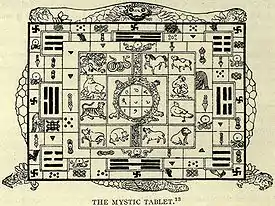
Bagua map
A bagua map is a tool used in Western forms of feng shui to map a room or location and see how the different sections correspond to different aspects in one's life. These sections are believed to relate to every area or aspect of life and are divided into such categories as: fame, relationships/marriage, children/creativity, helpful people/travel, career, inner knowledge, family/ancestors/health, and wealth/blessings.
In this system, the map is intended to be used over the land, one's home, office or desk to find areas lacking good chi, and to show where there are negative or missing spaces that may need rectifying or enhancing in life or the environment.
For example, if the bagua grid is placed over the entire house plan and it shows the toilet, bathroom, laundry, or kitchen in the wealth/blessings area it would be considered that the money coming into that particular environment would disappear very fast, as if to be 'going down the drain.'
In Unicode
The bagua symbols are in the Miscellaneous Symbols block of Unicode:
| Official Name | Glyph | Unicode # | HTML |
|---|---|---|---|
| Trigram for Heaven | ☰ | U+2630 | ☰ |
| Trigram for Lake | ☱ | U+2631 | ☱ |
| Trigram for Fire | ☲ | U+2632 | ☲ |
| Trigram for Thunder | ☳ | U+2633 | ☳ |
| Trigram for Wind | ☴ | U+2634 | ☴ |
| Trigram for Water | ☵ | U+2635 | ☵ |
| Trigram for Mountain | ☶ | U+2636 | ☶ |
| Trigram for Earth | ☷ | U+2637 | ☷ |
In culture
In Peking Opera, a role that has Taoist technique or military strategy wears a costume decorated with Taiji and Bagua.
Baguazhang and Taijiquan are two Chinese martial arts based on principles derived from bagua.
Other adoptions
- Flag of South Korea: a flag have four trigrams surrounding the taegeuk.
- Singapore dollar: the one dollar coin is shaped like a bagua.
- Flag of South Vietnam: the three stripes is said as a trigram representing "south".
- Tekes County and Zhuge Village: both these communities has a layout based on bagua.
See also
- Tian gan and Di zhi: the archaic calendar system of East Asia.
- Ba Xian
- Ba Mai (奇經八脈; qí jīng bā mài)
- Ba Duan Jin
References
- CHEN, Xin (tr. Alex Golstein). The Illustrated Canon of Chen Family Taijiquan, INBI Matrix Pty Ltd, 2007. page 11. (accessed on Scribd.com, December 14, 2009.)
- Wilhelm, Richard (1950). The I Ching or Book of Changes. translated by Cary F. Baynes, forward by C. G. Jung, preface to 3rd ed. by Hellmut Wilhelm (1967). Princeton, NJ: Princeton University Press. pp. 266, 269. ISBN 069109750X.
- TSUEI, Wei. Roots of Chinese culture and medicine Archived 2012-08-12 at the Wayback Machine Chinese Culture Books Co., 1989.
- ZONG, Xiao-Fan and Liscum, Gary. Chinese Medical Palmistry: Your Health in Your Hand, Blue Poppy Press, 1999.
- "Extraordinary Master-Coupled Theory and Applications". theory.yinyanghouse.com.
- Wilhelm, R. & Baynes, C., (1967): "The I Ching or Book of Changes", With foreword by Carl Jung, Introduction, Bollingen Series XIX, Princeton University Press, (1st ed. 1950)
- Chun Ming Chan,《由《輔行訣臟腑用藥法要》到香港當代新經學》,Amazon,
- Cisek, Jan. Feng Shui London blog, 2007.
- Moran, Elizabeth and Master Yu, Joseph. The Complete Idiot's Guide to Feng Shui, 3rd Edition, Penguin, 2005.