Athletics at the 1988 Summer Olympics – Men's high jump
The men's high jump competition at the 1988 Summer Olympics in Seoul, South Korea had an entry list of 27 competitors from 18 nations, with two qualifying groups (27 jumpers) before the final (16) took place on Sunday September 25, 1988. The maximum number of athletes per nation had been set at 3 since the 1930 Olympic Congress. There were two bronze medals awarded.[1] The event was won by Hennadiy Avdyeyenko of the Soviet Union, the nation's first victory in the men's high jump since 1972 and fourth overall. Hollis Conway's silver returned the United States to the podium after a two-Games absence (boycotted in 1980; best place was fourth in 1984) that had disrupted the American streak of medaling in every Olympic men's high jump. Patrik Sjöberg's bronze made Sweden the fourth nation (and Sjöberg the fifth man) to medal in two consecutive Games, after the United States, the Soviet Union, and France. The other bronze medal went to Rudolf Povarnitsyn of the Soviet Union after the countback could not break the tie for third.
| Men's high jump at the Games of the XXIV Olympiad | |||||||||||||
|---|---|---|---|---|---|---|---|---|---|---|---|---|---|
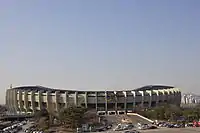 Olympic Stadium (2014) | |||||||||||||
| Venue | Olympic Stadium | ||||||||||||
| Date | 24 September | ||||||||||||
| Competitors | 27 from 18 nations | ||||||||||||
| Winning height | 2.38 OR | ||||||||||||
| Medalists | |||||||||||||
| |||||||||||||
| Athletics at the 1988 Summer Olympics | ||
|---|---|---|
 | ||
| Track events | ||
| 100 m | men | women |
| 200 m | men | women |
| 400 m | men | women |
| 800 m | men | women |
| 1500 m | men | women |
| 3000 m | women | |
| 5000 m | men | |
| 10,000 m | men | women |
| 100 m hurdles | women | |
| 110 m hurdles | men | |
| 400 m hurdles | men | women |
| 3000 m steeplechase | men | |
| 4×100 m relay | men | women |
| 4×400 m relay | men | women |
| Road events | ||
| Marathon | men | women |
| 20 km walk | men | |
| 50 km walk | men | |
| Field events | ||
| Long jump | men | women |
| Triple jump | men | |
| High jump | men | women |
| Pole vault | men | |
| Shot put | men | women |
| Discus throw | men | women |
| Javelin throw | men | women |
| Hammer throw | men | |
| Combined events | ||
| Heptathlon | women | |
| Decathlon | men | |
| Wheelchair races | ||
Background
This was the 21st appearance of the event, which is one of 12 athletics events to have been held at every Summer Olympics. The returning finalists from the 1984 Games were gold medalist Dietmar Mögenburg of West Germany, silver medalist Patrik Sjöberg of Sweden, bronze medalist Zhu Jianhua of China, sixth-place finisher Milton Ottey of Canada, and tenth-place finisher Carlo Thränhardt of West Germany. For the third straight Games, a boycott affected the high jump favorites; this time, world record holder Javier Sotomayor of Cuba was unable to compete. Without Sotomayor, it was difficult to select a favorite among the strong field which included five former world record holders. All three of the returning medalists had held the record at some point, as had Soviet team members Rudolf Povarnitsyn and Igor Paklin. The third Soviet, Hennadiy Avdyeyenko, had won the world championship in 1983 before missing the 1984 Games due boycott. Sjöberg was the reigning (1987) world champion.[2]
Burkina Faso made its debut in the event. The United States made its 20th appearance, most of any nation, having missed only the boycotted 1980 Games.
Competition format
The competition used the two-round format introduced in 1912. There were two distinct rounds of jumping with results cleared between rounds. Jumpers were eliminated if they had three consecutive failures, whether at a single height or between multiple heights if they attempted to advance before clearing a height.
The qualifying round had the bar set at 2.05 metres, 2.10 metres, 2.15 metres, 2.19 metres, 2.22 metres, 2.25 metres, and 2.28 metres. All jumpers clearing 2.28 metres in the qualifying round advanced to the final. If fewer than 12 jumpers could achieve it, the top 12 (including ties) would advance to the final.
The final had jumps at 2.15 metres, 2.20 metres, 2.25 metres, 2.28 metres, 2.31 metres, 2.34 metres, 2.36 metres, 2.38 metres, and 2.40 metres.[2][3]
Records
These were the standing world and Olympic records (in metres) prior to the 1988 Summer Olympics.
| World record |  Javier Sotomayor (CUB) | 2.43 | Salamanca, Spain | 8 September 1988 |
| Olympic record |  Gerd Wessig (GDR) | 2.36 | Moscow, Soviet Union | 1 August 1980 |
All four medalists matched the Olympic record at 2.36 metres before Hennadiy Avdyeyenko broke it at 2.38 metres to win the gold.
Schedule
All times are Korea Standard Time adjusted for daylight savings (UTC+10)
| Date | Time | Round |
|---|---|---|
| Saturday, 24 September 1988 | 12:00 | Qualifying |
| Saturday, 24 September 1988 | 12:10 | Final |
Results
Key
- o = Height cleared
- x = Height failed
- – = Height passed
- r = Retired
- SB = Season's best
- PB = Personal best
- NR = National record
- AR = Area record
- OR = Olympic record
- WR = World record
- WL = World lead
- NM = No mark
- DNS = Did not start
- DQ = Disqualified
Qualifying
Qualification: Qualifying Performance 2.28 (Q) or at least 12 best performers (q) advance to the final.

Final
The competition was marked by "passes and tactical maneuvers."[2]
| Rank | Athlete | Nation | 2.15 | 2.20 | 2.25 | 2.28 | 2.31 | 2.34 | 2.36 | 2.38 | 2.40 | 2.44 | Height | Notes |
|---|---|---|---|---|---|---|---|---|---|---|---|---|---|---|
 | Hennadiy Avdyeyenko |  Soviet Union | – | o | o | – | o | o | o | xo | x– | xx | 2.38 | OR |
 | Hollis Conway |  United States | – | xo | xo | o | o | xo | o | xxx | N/A | 2.36 | ||
 | Rudolf Povarnitsyn | Soviet Union | – | o | o | o | o | o | xo | xxx | N/A | 2.36 | ||
| Patrik Sjöberg |  Sweden | – | – | o | – | o | – | xo | xxx | N/A | 2.36 | |||
| 5 | Clarence Saunders |  Bermuda | – | o | xo | – | x– | o | x– | xx | N/A | 2.34 | ||
| 6 | Dietmar Mögenburg |  West Germany | – | – | o | – | xo | xo | x– | xx | N/A | 2.34 | ||
| 7 | Dalton Grant |  Great Britain | – | – | o | – | o | xxx | N/A | 2.31 | ||||
| Igor Paklin | Soviet Union | – | o | o | – | o | x– | xx | N/A | 2.31 | ||||
| Carlo Thränhardt | West Germany | – | – | o | – | o | xx– | x | N/A | 2.31 | ||||
| 10 | Jim Howard | United States | – | o | o | xo | o | xxx | N/A | 2.31 | ||||
| 11 | Brian Stanton | United States | o | – | o | o | xo | xxx | N/A | 2.31 | ||||
| 12 | Krzysztof Krawczyk |  Poland | – | o | o | xo | xxo | xxx | N/A | 2.31 | ||||
| 13 | Luca Toso |  Italy | xo | o | o | xxx | N/A | 2.25 | ||||||
| 14 | Arturo Ortiz |  Spain | o | – | xxo | xxx | N/A | 2.25 | ||||||
| 15 | Robert Ruffini |  Czechoslovakia | o | xxo | xxx | N/A | 2.20 | |||||||
| 16 | Geoff Parsons | Great Britain | o | – | xxx | N/A | 2.15 | |||||||
See also
References
- "Athletics at the 1988 Seoul Summer Games: Men's High Jump". sports-reference.com. Archived from the original on 17 April 2020. Retrieved 1 January 2018.
- "High Jump, Men". Olympedia. Retrieved 16 September 2020.
- Official Report, vol. 2, p. 242.
External links
- (in English) Official Report