Anorthoclase
The mineral anorthoclase ((Na,K)AlSi3O8) is a crystalline solid solution in the alkali feldspar series, in which the sodium-aluminium silicate member exists in larger proportion. It typically consists of between 10 and 36 percent of KAlSi3O8 and between 64 and 90 percent of NaAlSi3O8.[4]
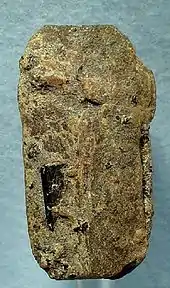
| Anorthoclase | |
|---|---|
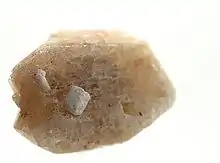 Doubly terminated anorthoclase crystal from Kinki Region, Honshu island, Japan (size: 1.3 x 0.9 x 0.7 cm) | |
| General | |
| Category | Feldspar |
| Formula (repeating unit) | (Na,K)AlSi3O8 |
| Strunz classification | 9.FA.30 |
| Crystal system | Triclinic |
| Crystal class | Pinacoidal (1) (same H-M symbol) |
| Space group | C1 |
| Unit cell | a = 8.28, b = 12.97 c = 7.15 [Å]; α = 91.05° β = 116.26°, γ = 90.15°; Z = 4 |
| Identification | |
| Color | Colorless, also white, pale creamy yellow, red, green |
| Crystal habit | Short prismatic crystals; tabular, rhombic, flattened along [010] |
| Twinning | Polysynthetic twinning produces a grid pattern on [100] |
| Cleavage | Perfect on [001], other partings |
| Fracture | Uneven |
| Tenacity | Brittle |
| Mohs scale hardness | 6 |
| Luster | Vitreous to pearly on cleavage planes |
| Streak | White |
| Diaphaneity | Transparent |
| Specific gravity | 2.57 - 2.60 |
| Optical properties | Biaxial (-) |
| Refractive index | nα = 1.519 - 1.529 nβ = 1.524 - 1.534 nγ = 1.527 - 1.536 |
| Birefringence | δ = 0.008 |
| 2V angle | Measured: 34° to 60° |
| References | [1][2][3] |
Structure and stability
Anorthoclase is an intermediate member of the high albite – sanidine alkali feldspar solid solution series. Intermediate members of this series, high albite, anorthoclase and high sodium sanidine are stable at temperatures of 600 °C (1,112 °F) and above. Below 400 to 600 °C only very limited solution exists (less than about 5% on both the low albite and microcline ends).[5] Anorthoclase and high albite exhibit triclinic symmetry, whereas sanidine and the low temperature orthoclase have monoclinic symmetry.[5] If the high temperature intermediate composition alkali feldspars are allowed to cool slowly, exsolution occurs and a perthite structure results.[5]
Occurrence
Anorthoclase occurs in high temperature sodium rich volcanic and hypabyssal (shallow intrusive) rocks. The mineral is typically found as a constituent of the fine grained matrix or as small phenocrysts which may occur as loose crystals in a weathered rock.[1]
It was first described in 1885 for an occurrence on Pantelleria Island, Trapani Province, Sicily. The name is from the Greek αν, ορθός and κλάσις (not cleaving at right-angles), for its oblique cleavage.[1][2]
See also
References
- Handbook of Mineralogy
- Mindat.org
- Webmineral data
- Deere, Howie and Zussman, Rock Forming Minerals, Vol. 4 Framework Silicates, Wiley, pp. 2 - 5, Fig. 1
- Klein, Cornelis and Cornelius S. Hurlbut, Jr. Handbook of Mineralogy, Wiley, pp. 446-449 (Fig. 11-95 ISBN 0-471-80580-7